

In the dynamic world of small plastic parts manufacturing, injection molding stands as a cornerstone process. As a dedicated small plastic parts supplier, I've witnessed firsthand how various factors can significantly influence the quality and characteristics of the final products. One such crucial factor is the screw speed during the injection molding process. In this blog, I'll delve into the effects of different screw speeds on small plastic parts, sharing insights based on my experiences and industry knowledge.
Understanding Screw Speed in Injection Molding
Before we explore the effects, it's essential to understand what screw speed means in the context of injection molding. The screw in an injection molding machine serves multiple functions. It rotates to convey, compress, and melt the plastic pellets fed into the hopper. Once the plastic is in a molten state, the screw moves forward to inject the material into the mold cavity. The screw speed refers to the rotational speed of this screw, typically measured in revolutions per minute (RPM).
Impact on Plastic Melting and Homogeneity
The screw speed plays a vital role in the melting process of plastic. A higher screw speed generally leads to more intense shearing forces within the plastic material. Shearing forces occur when adjacent layers of the plastic move relative to each other as the screw rotates. This shearing action generates heat, which aids in melting the plastic pellets.
When the screw speed is set too low, the plastic may not melt uniformly. Some pellets might remain partially solid, resulting in a heterogeneous melt. This can lead to visible defects in the final small plastic parts, such as streaks or inconsistent coloration. On the other hand, a very high screw speed can cause excessive shearing and overheating of the plastic. This overheating can degrade the polymer chains, altering the material's properties and potentially reducing the mechanical strength of the parts.
For small plastic parts, achieving a homogeneous melt is crucial. These parts often have intricate designs and tight tolerances, and any variation in the material properties can affect their functionality. As a supplier, I always aim to find the optimal screw speed to ensure a consistent and high - quality melt for each type of plastic we use.
Influence on Filling of the Mold Cavity
The filling of the mold cavity is another critical aspect affected by screw speed. A faster screw speed can increase the injection rate, allowing the molten plastic to flow more quickly into the mold. This can be beneficial for small plastic parts with complex geometries or thin walls. In such cases, a high injection rate can help the plastic reach all corners of the mold before it starts to solidify, reducing the risk of short shots (incomplete filling of the mold).
However, a very high screw speed during filling can also cause problems. The rapid flow of plastic can create high pressures within the mold, leading to issues like flash (excess plastic that seeps out of the mold seams). Additionally, the fast - moving plastic can cause air to be trapped inside the mold cavity, resulting in voids or bubbles in the final parts.
Conversely, a slow screw speed may lead to insufficient filling, especially for parts with long flow paths or small cross - sectional areas. The plastic may cool down too much before reaching the far ends of the mold, causing the part to be under - formed.
Effects on Part Appearance and Surface Finish
The surface finish of small plastic parts is often a key consideration for our customers. Screw speed can have a significant impact on this aspect. A proper screw speed helps in achieving a smooth and glossy surface. When the screw speed is well - calibrated, the plastic flows evenly into the mold, filling all the details without creating any surface irregularities.
If the screw speed is too high, the plastic may flow turbulently into the mold. This turbulent flow can cause surface defects such as flow marks or weld lines. Flow marks are visible streaks on the surface of the part, while weld lines occur when two or more flow fronts of plastic meet and fuse together in the mold. These defects not only affect the aesthetic appeal of the parts but can also weaken the part at the affected areas.
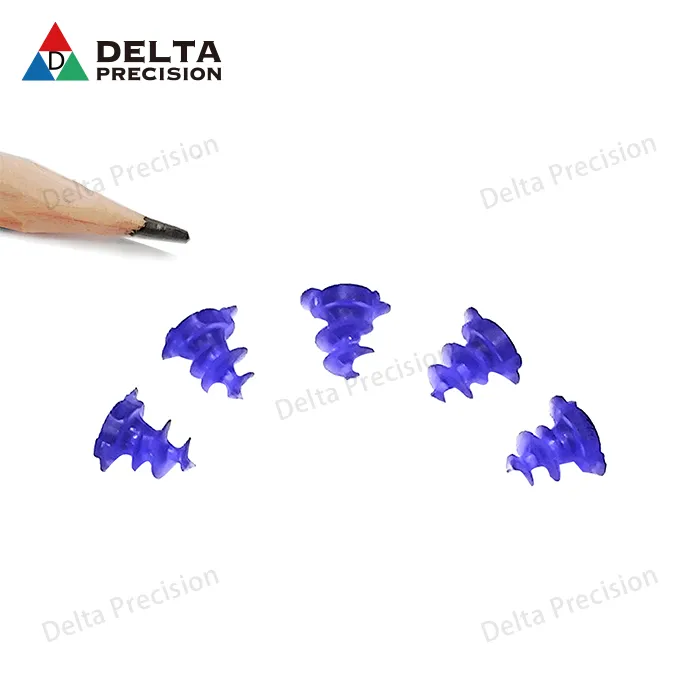

A low screw speed, on the other hand, may result in a dull or rough surface finish. The slow - moving plastic may not fully replicate the fine details of the mold surface, leaving a less - than - perfect appearance.
Impact on Part Dimensions and Tolerances
Maintaining accurate dimensions and tight tolerances is essential for small plastic parts, especially in applications where they need to fit precisely with other components. Screw speed can influence part dimensions in several ways.
During the cooling phase, the shrinkage of the plastic is an important factor. A high screw speed can lead to a more uniform distribution of heat within the plastic during injection. This can result in more consistent shrinkage across the part, helping to maintain the desired dimensions. However, if the high screw speed causes overheating and degradation of the plastic, the shrinkage behavior may become unpredictable, leading to dimensional variations.
A low screw speed may cause uneven cooling and shrinkage, as the plastic may cool at different rates in different parts of the mold. This can lead to warping or distortion of the small plastic parts, making them out of tolerance.
Finding the Optimal Screw Speed
As a small plastic parts supplier, finding the optimal screw speed for each project is a continuous process of experimentation and optimization. We consider several factors when determining the appropriate screw speed, including the type of plastic material, the design of the part, and the characteristics of the injection molding machine.
For different plastic materials, their melting points, viscosity, and shear sensitivity vary. For example, amorphous plastics like polystyrene generally have a lower viscosity and are less sensitive to shear compared to semi - crystalline plastics like polypropylene. Therefore, the optimal screw speed for these two types of plastics will be different.
The part design also plays a crucial role. Parts with complex geometries or thin walls may require a different screw speed than simple, thick - walled parts. We often use computer - aided engineering (CAE) simulations to predict the flow behavior of the plastic at different screw speeds and optimize the process parameters before actual production.
Conclusion
In conclusion, screw speed is a critical parameter in the injection molding of small plastic parts. It affects various aspects of the final product, including melting, filling, appearance, and dimensions. As a small plastic parts supplier, I'm constantly striving to understand and control the effects of screw speed to ensure the highest quality of our products.
If you're in the market for high - quality small plastic parts, I encourage you to reach out to us for a detailed discussion. We have the expertise and experience to optimize the injection molding process, including the selection of the right screw speed, to meet your specific requirements. Whether you need Small Part Injection Molding or Micro Injection Molding, we're here to provide you with the best solutions. Contact us today to start the procurement process and see how we can add value to your projects.
References
- Beaumont, J. P. (2007). Injection Molding Troubleshooting Handbook. Hanser Gardner Publications.
- Rosato, D. V., & Rosato, D. P. (2000). Injection Molding Handbook. Kluwer Academic Publishers.
- Throne, J. L. (1996). Thermoplastic Injection Molding: Materials, Processing, and Tooling. Marcel Dekker.