

Hey there! As a supplier in the CNC precision machining industry, I've seen firsthand the amazing capabilities and importance of CNC turning. So, let's dive into what CNC turning is all about in precision machining.
What's CNC Turning Anyway?
CNC turning is a super cool manufacturing process that's part of the precision machining world. In simple terms, it's like a high - tech lathe operation. You've probably seen old - school lathes in some industrial movies or workshops. Well, CNC turning takes that basic concept and kicks it up a notch with computer control.
Here's how it works. You start with a block of raw material, which can be metal, plastic, or even wood. This material is called the workpiece. The workpiece is clamped onto a spindle, which rotates at high speeds. Meanwhile, a cutting tool is carefully positioned and moved along the spinning workpiece. The cutting tool removes material from the workpiece, shaping it into the desired form. And the best part? All of this movement of the cutting tool is controlled by a computer program.
This computer program is written based on a detailed design. It tells the cutting tool exactly where to go, how fast to move, and how deep to cut. This precision is what makes CNC turning so great for creating parts with very tight tolerances. We're talking about parts where the measurements need to be accurate down to a few thousandths of an inch.
Why CNC Turning Rocks in Precision Machining
One of the biggest advantages of CNC turning is its repeatability. Once you've got the computer program set up for a particular part, you can make hundreds or thousands of identical parts. Each part will have the same high - quality finish and precise dimensions. This is crucial for industries like automotive and aerospace, where every single part needs to meet strict standards.
Another great thing about CNC turning is its efficiency. The computer - controlled process is much faster than manual machining. It can work around the clock without getting tired or making mistakes due to fatigue. This means we can produce parts in large quantities in a relatively short amount of time.
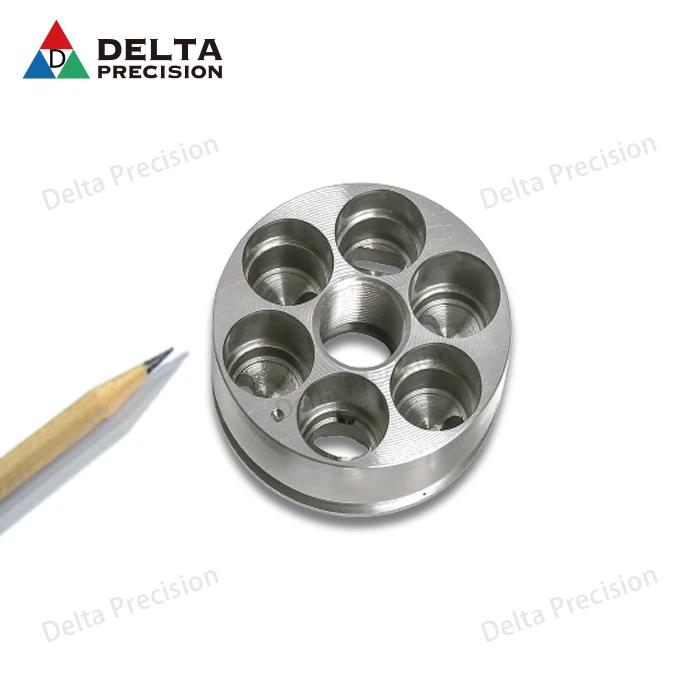
CNC turning also allows for a high degree of complexity in part design. We can create parts with intricate shapes, such as threads, tapers, and grooves. These complex features can be very difficult or even impossible to achieve with manual machining methods.
The Different Types of CNC Turning
There are a few different types of CNC turning processes that we often use in our precision machining services.
CNC Turning Centers
These are the most common type of CNC turning machines. They are versatile and can handle a wide range of part sizes and materials. A CNC turning center typically has a single spindle and one or more cutting tools. The cutting tools can be changed automatically, which allows for different machining operations to be performed on the same part without having to remove it from the machine.
Multi - spindle Machining
This is a more advanced form of CNC turning. In multi - spindle machining, there are multiple spindles that can hold workpieces at the same time. Each spindle can be working on a different part or different operations on the same part. This significantly increases the production rate. For example, in a multi - spindle lathe, several parts can be machined simultaneously, reducing the overall production time per part.
Automatic Bar Machining
Automatic bar machining is great for producing small, cylindrical parts in large quantities. In this process, a long bar of material is fed into the machine. As the bar rotates, the cutting tools shape the material into the desired parts. Once a part is finished, it is automatically cut off from the bar, and the process continues with the next part. This type of CNC turning is highly efficient and is often used for making things like screws, bolts, and pins.

The Materials We Can Work With in CNC Turning
We can use a wide variety of materials in CNC turning. Here are some of the most common ones:
Metals
Metals are probably the most widely used materials in CNC turning. Aluminum is a popular choice because it's lightweight, corrosion - resistant, and easy to machine. Stainless steel is another great option. It's strong, durable, and has excellent resistance to heat and corrosion. We also work with brass, which is known for its good electrical conductivity and attractive appearance. And for high - strength applications, we use materials like titanium and alloy steels.
Plastics
Plastics are becoming more and more important in precision machining. They are lightweight, inexpensive, and can be molded into complex shapes. We can work with a variety of plastics, including acrylic, nylon, and polycarbonate. These plastics are often used in industries like electronics and medical devices.
Composites
Composites are materials made up of two or more different materials. For example, carbon fiber composites are very strong and lightweight. They are used in aerospace and automotive industries to reduce weight and improve performance. CNC turning can be used to machine composites to the exact specifications required for these high - tech applications.
Our Experience as a CNC Precision Machining Supplier
As a CNC precision machining supplier, we've had the opportunity to work on some really interesting projects. We've made parts for everything from small consumer products to large industrial machinery.
One of our recent projects was for a medical device company. They needed a very precise component for a new surgical instrument. The part had to be made from a special type of stainless steel and had some very tight tolerances. Using our CNC turning capabilities, we were able to produce the part with the required precision. We also worked closely with the customer to ensure that the part met all of their functional and aesthetic requirements.
Another project was for an automotive company. They were developing a new engine component that needed to be lightweight but still strong. We used aluminum in our CNC turning process to create the part. The computer - controlled machining allowed us to optimize the design for strength while minimizing the weight. The end result was a high - performance part that helped improve the overall efficiency of the engine.
How CNC Turning Fits into the Bigger Picture of Precision Machining
CNC turning is just one part of the precision machining puzzle. In many cases, we use it in combination with other machining processes to create a complete part. For example, after a part is turned on a CNC lathe, it might need to go through a milling process to add some flat surfaces or holes. Or it might need to be ground to achieve an even smoother finish.
We also offer secondary operations like heat treatment, plating, and assembly. Heat treatment can improve the strength and hardness of a part, while plating can provide corrosion resistance or an attractive finish. Assembly services allow us to put together multiple parts to create a complete product.
Contact Us for Your CNC Turning Needs
If you're in need of high - quality precision - machined parts, we'd love to hear from you. Whether you have a small - scale project or a large - volume production order, we have the expertise and equipment to handle it. Our team of experienced engineers and machinists will work closely with you to understand your requirements and come up with the best solution.
We're committed to providing the highest level of quality and service. We use the latest CNC turning technology to ensure that your parts are made with the utmost precision. And we offer competitive pricing and fast turnaround times.
So, if you're looking for a reliable CNC Turning supplier, don't hesitate to reach out. We're here to help you bring your ideas to life and get your products to market faster.
References
- ASM Handbook, Volume 16: Machining, ASM International
- Modern Manufacturing Processes, McGraw - Hill Education
- Precision Machining Technology, Society of Manufacturing Engineers